Create springs between the bogie and the axles, located at the same place as the brake disks. The property of the springs does not include a stiffness, they only contains a preload force which corresponds to the braking force.
  func  const  Fbrake=  28553.362
  func  const  Rbrake=  0.235

  coupl p_lin  kdbrakep1=  Fbrake  0.
  coupl p_lin  kdbrakep2= -Fbrake  0.

  coupl k kdbr_111 axl_111 -Rbrake 0 -ro  bog_11  (aba-Rbrake) 0 -ro  kdbrakep1 esys1 z
  coupl k kdbr_112 axl_112 +Rbrake 0 -ro  bog_11 -(aba-Rbrake) 0 -ro  kdbrakep2 esys1 z
  coupl k kdbr_121 axl_121 -Rbrake 0 -ro  bog_12  (aba-Rbrake) 0 -ro  kdbrakep1 esys1 z
  coupl k kdbr_122 axl_122 +Rbrake 0 -ro  bog_12 -(aba-Rbrake) 0 -ro  kdbrakep2 esys1 z
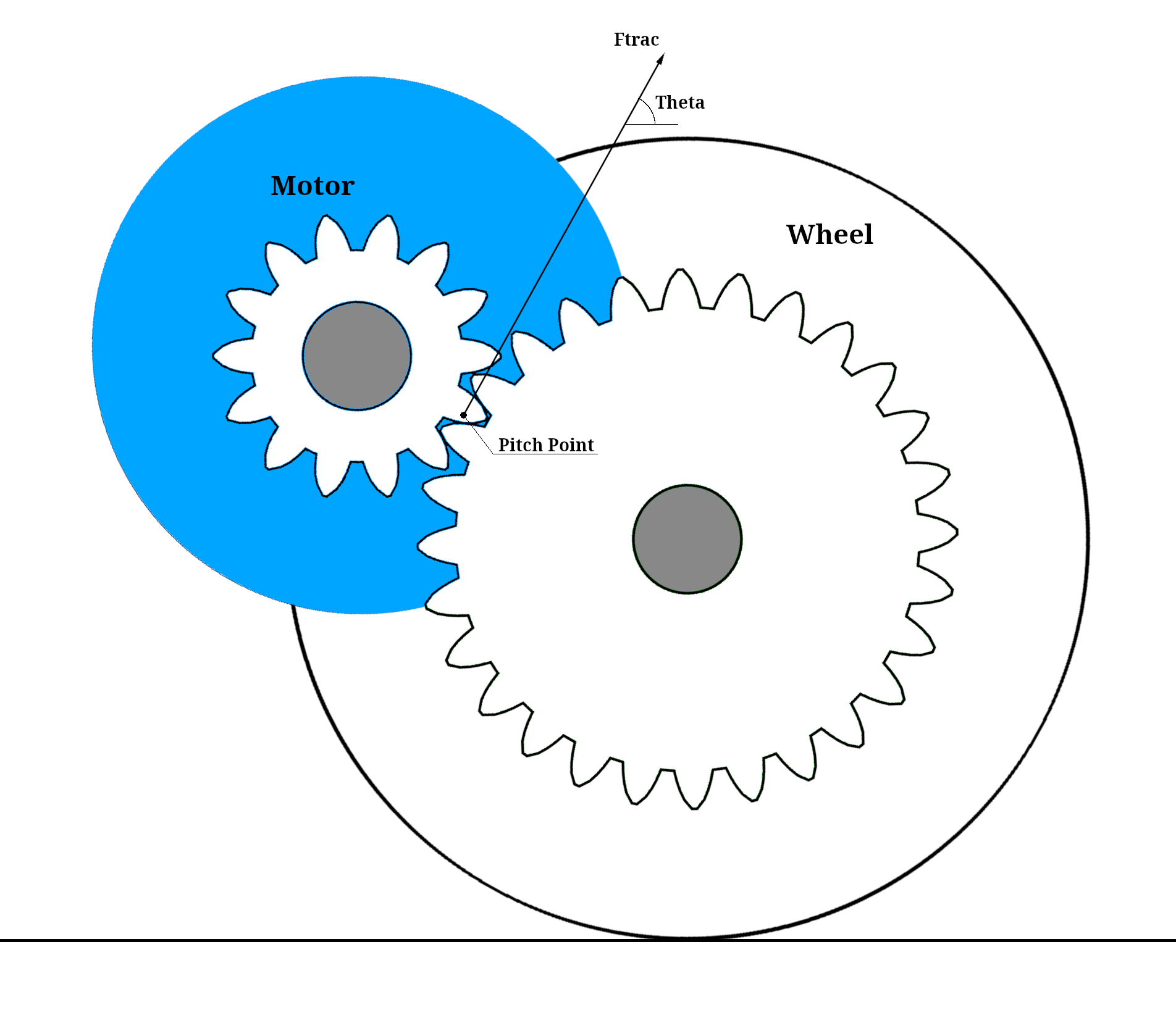
Traction simulation is very similar to Brake simulation. However, often the center of two cogwheels in the gearbox are on different heights, why the cog-force will have an angle Theta relative to the horizontal plane. Therefore, it can be more practical to define the traction force with the force-command instead. The cogwheel forces shall have different signs on the two cogwheels.
  func  const      Ftrac=   28553.362                  # Total cogwheel force
  func  operp_init FtracX=  cos( theta ) * Ftrac       # Longitudinal component of the cogwheel force
  func  operp_init FtracZ= -sin( theta ) * Ftrac       # Vertical component of the cogwheel force
  force rel_mass1  cogForceW axl_111    -0.235 0.435 -0.65   FtracX 0  FtracZ  0 0 0     # Positive sign on wheelset
  force rel_mass1  cogForceM mot_111 aba-0.235 0.435 -0.65  -FtracX 0 -FtracZ  0 0 0     # Negative sign on motor
Theta is the angle relative to the horizontal plane in which the resulting cog-forces are acting.
In this example the pitch point of the cogwheel is defined with the three values (-0.235, 0.435, -0.65) relative to the wheelsets coordinate system lsa_XXX.
Often the motor is defined in the bogie coordinate system lsb_XX, therefore the pitch point for the motor becomes (aba-0.235, 0.435, -0.65).